Selling a Waterfront Home in Jupiter: Pricing, Presentation and Buyer Concerns
Why a Jupiter Waterfront Sale Is Its Own Discipline
Selling on the water in Jupiter is not the same exercise as selling a comparable dry-lot home a few streets inland. Here, the value, and the scrutiny, concentrates on the part of the property that most sellers think about least: the seawall, the dock, the depth at low tide, and exactly how a boat gets from your backyard to the Atlantic. A buyer who can write a check for a Jupiter waterfront home has usually toured several, knows what direct ocean access feels like versus a canal behind a fixed bridge, and brings a marine surveyor of their own. That changes how you should price and present from the first day the sign goes up.
The town's waterfront inventory is also deep and varied. Across Jupiter there are hundreds of waterfront homes listed at any given time, spanning Loxahatchee River frontage, Intracoastal lots, canal homes, and the gated golf-and-yacht communities, and the asking range runs from the entry waterfront tier into eight figures for premier inlet-access estates. That spread is exactly why a single anchoring number does not exist for a Jupiter waterfront seller. The right price comes from your specific water, your specific access, and live market data, not a citywide average. For the broader setting, the Jupiter community guide and the current Jupiter listings show how wide that band really is.
- Price it right on day one. Industry research, including Zillow's work on overpricing, finds that homes listed above market tend to sit far longer, collect price cuts, and often sell for less than they would have at a correct price. The most motivated, actively searching buyers see your listing in its first weeks, and overpricing wastes that window.
- Lead with the water. Stage and photograph from the water inward, market the home to the buyer your specific access actually fits, and treat the dock as a primary selling asset, not a backyard afterthought.
- Get ahead of the buyer's questions. Seawall life, dock and lift condition, low-tide depth, dock rights, flood insurance, and Florida's expanded flood-disclosure rules are where waterfront deals are won or lost, so address them before due diligence does.
Why Overpricing Hurts a High-Value Listing Most
The single most expensive mistake a Jupiter waterfront seller can make is reaching on price. It feels like the safe move, leave room to negotiate, test the top of the market, and you can always come down. On a high-value listing, that logic runs backwards. Zillow's research on overpricing and a long line of agent reporting point the same direction: an overpriced home tends to take far longer to sell and frequently closes below what a correctly priced listing would have achieved. A widely repeated industry pattern puts an overpriced listing's time on market at roughly three times the average, eventually selling around ten percent or more under true market value. Treat that as a general tendency rather than a guaranteed figure, but the direction is not in dispute.
The reason is about timing and attention. A new listing gets its largest, most motivated audience in its first weeks on market, the buyers who have been watching the segment, have financing ready, and recognize the right home immediately. Price above what they will pay and those buyers simply move on, leaving the listing to drift toward a thinner, more skeptical audience. One 2026 framing of the seller's clock is blunt: by week four, a listing is either drawing offers or drawing price cuts. The window where pricing discipline pays off is early, and it does not reopen.
The stale-listing penalty compounds
Time on market is not neutral, it is a signal. The longer a waterfront home sits, the more buyers assume something is wrong, with the seawall, the access, the price, or all three, and they grow hesitant even after a reduction. Price cuts that arrive late can read as a seller under pressure, which invites lower offers rather than fairer ones. Fast Company described the underlying mistake plainly in 2026: the costly error starts on day one. And the move-up and luxury tier that once drew bidding wars has cooled relative to a few years ago, with final sale prices in that segment now falling among the furthest below asking. For a Jupiter waterfront seller priced at or above the luxury floor, that is precisely the band where pricing discipline matters most.
— Dylan Snyder, The Snyder Group | Compass
Pricing a waterfront home correctly starts with an honest read of what your water actually supports, then a live look at comparable closings. A professional home valuation is the right first step, and the home sale calculator helps you model net proceeds once a realistic price is on the table. If you are also tracking where the broader market sits, the Jupiter market update keeps the context current.
What Actually Sets a Jupiter Waterfront Price
Once the discipline of day-one pricing is settled, the next question is what your specific home should be priced against. On the water in Jupiter, the answer turns on access far more than square footage. The single biggest value driver is the route to the ocean.
Ocean access and the fixed-bridge question
Homes with direct ocean access and no fixed bridges between the dock and the Jupiter Inlet command a premium and draw serious boaters, because that access supports larger vessels with outriggers, tuna towers, and tall flybridges. By contrast, homes on the forks of the Loxahatchee River sit behind fixed bridges with roughly twelve to fourteen feet of clearance, depending on the span, which restricts the size and type of boat that can reach open water. Communities behind those fixed bridges, among them Loxahatchee Pointe, Tequesta Country Club, Turtle Creek, Pennock Point, and The Islands of Jupiter, are still genuinely desirable waterfront, but they are a different product priced for a different buyer. A seller's job is to know exactly what their water supports and market honestly to the matching buyer, rather than pricing as though every waterfront lot is interchangeable.
The dock, the depth, and the hardware
Beyond access, the physical waterfront assets carry real, separable value: dock length and structure, water depth at the dock at low tide, the boat lift and its capacity, and seawall condition. A long, deep-water dock is a premium feature in its own right, the kind of asset that justifies its own line in the marketing rather than a passing mention. The right comparison set is not "waterfront homes in Jupiter" in the abstract, but homes whose access, depth, and dockage match yours.
Direct Ocean Access, No Fixed Bridges
The premium tier for serious boaters. Deep-water communities such as Admirals Cove and Jonathan's Landing pair dockage with quick inlet access. Price and market to buyers who keep a real boat.
Browse deep-water communities →River Frontage Behind Fixed Bridges
Loxahatchee River-fork homes near Tequesta offer beautiful water and a quieter price, with clearance limits that cap boat size. A different, honest pitch to a different buyer, not a discount on the same product.
Browse river-area homes →If your home sits in one of the gated golf-and-yacht communities, the club layer shapes price as much as the dock does. The companion guides for Frenchman's Creek and North Palm Beach show how membership and marina access fold into value, and you can see live inventory through Frenchman's Creek listings and North Palm Beach listings.
How to Present the Home and Pre-Empt Buyer Concerns
With pricing and positioning set, presentation is what converts the right buyer into an offer, and preparation is what keeps that offer alive through inspection. On the water, both have a specific playbook.
Stage and photograph from the water inward
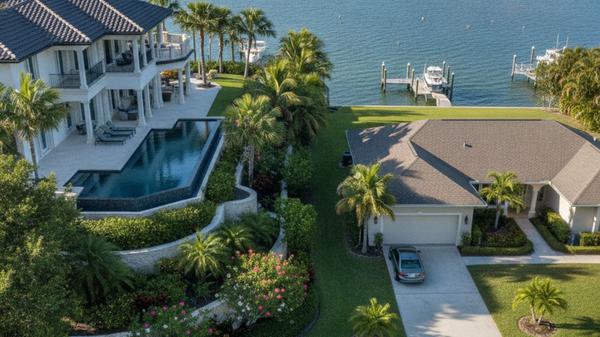
The most important sequence in a waterfront showing is the sightline from the main living space, through the glass, to the water. Stage to protect it: remove heavy window treatments that block the view, and face furniture toward the water rather than toward a television or a wall. The dock is one of the strongest selling assets you have, so clear it of hoses, pool toys, weathered furniture, and aging gear that photograph as deferred maintenance. For photography, shoot exteriors and the dock at golden hour, interiors at midday, and consider a twilight hero image, with a drone or aerial frame to show the home's relationship to open water and the channel. Buyers shopping this segment are reading the water, the access, and the upkeep as much as the kitchen, so the imagery has to carry all three.
Answer the inspection before the inspector does
Waterfront deals come apart in due diligence more often than on price, and most of those failures are foreseeable. A prepared seller gets ahead of them. The recurring concerns a Jupiter buyer and their marine surveyor will raise are predictable enough to document in advance.
| Seawall | Condition and remaining useful life, the first thing a marine surveyor evaluates and a common deal-shaper. |
| Dock & pilings | Structure, pilings, and hardware condition; have records of any recent work. |
| Low-tide depth | Usable water depth at the dock at low tide, not just at high water, the number serious boaters ask for first. |
| Boat lift | Lift condition and capacity relative to the vessel a buyer is likely to keep. |
| Shoreline | Any erosion or scour, and how it has been managed. |
| Dock rights | Deeded dock vs. permitted-but-not-deeded vs. riparian rights with no dock, a distinction that materially changes the offer. |
| Permits | The Town of Jupiter requires permits for docks, boat lifts, and seawall work; unpermitted prior work can limit future projects and surfaces in diligence. |
Having the documentation ready, permits, the elevation certificate, and records of dock or seawall work, does more than smooth the transaction. It signals a well-kept property and removes the uncertainty that otherwise becomes a price negotiation. When you are ready to map this out for your specific home, meet the team and we will build the pre-listing prep list together.
Flood insurance, elevation, and FEMA
Waterfront homes in Florida almost universally sit in FEMA flood zones, so flood insurance is effectively part of the ownership math, and its cost varies by zone, elevation, foundation, and replacement cost. Under FEMA's Risk Rating 2.0, two homes on the same street can carry materially different premiums, which means a buyer cannot simply assume the neighbor's quote applies. A smart seller has the elevation certificate in hand and points buyers to the official sources: the FEMA Flood Map Service Center for the zone and the Palm Beach County Property Appraiser for parcel and property data. Removing that unknown early keeps it from becoming a late-stage surprise.
The Disclosure Rule That Changed in 2025
Effective October 1, 2025, Florida expanded what sellers of residential property must disclose about flooding under Senate Bill 948 (Chapter 2025-166; Fla. Stat. 689.302). The change is concrete and directly relevant to any Jupiter waterfront seller:
- Flood damage during ownership must be disclosed, even when no insurance claim was ever filed.
- Flood-remediation assistance from any source must be disclosed, no longer limited to federal assistance.
- The duty turns on the seller's knowledge, which makes accurate, documented record-keeping about prior water events part of preparing to sell.
This is general information, not legal advice. Because it is a legal matter, confirm how the law applies to your property with your attorney and your agent before completing any disclosure.
Beyond the disclosure rule, the broader caveat is that waterfront specifics, bridge clearances, dock-permit status, flood-zone designations, and club membership terms, change and are property-specific. Verify each by exact address before relying on it, and treat any pricing pattern in this article as a general tendency rather than a fixed number.
How Access Shapes Price: Admirals Cove
For a working illustration of how access, depth, and amenity stack into a waterfront price, Admirals Cove is the clearest example in Jupiter, used here as a community-level reference rather than a specific transaction. It is a private golf-and-waterfront community minutes from the Jupiter Inlet, with direct Intracoastal access, more than 800 deep-water docks community-wide, and a 63-slip deep-water marina reported to accommodate vessels up to roughly 130 feet. It pairs that boating infrastructure with 45 holes of championship golf, including the East Course by Robert von Hagge, and a mandatory club membership with initiation fees reported in the range of about $285,000 to $475,000 by tier.
The pricing that results spans a wide band, from golf villas into the multi-millions and into the $20 million-plus range for premier waterfront estates, with one source citing a community single-family median around $8.25 million. Treat those figures as reported by community and agent sources rather than as official club or MLS data, and verify before relying on them, club terms in particular change. The point of the example is the logic, not the exact dollar: in a community like this, deep-water dockage, true ocean access, and a club membership are not background features, they are the value, and they explain why two homes of similar size can price worlds apart.
Admirals Cove
Deep-water dockage, a 63-slip marina, 45 holes of golf, and direct access to the inlet. The clearest case of access-and-amenity driving waterfront price.
Admirals Cove homes →If you are weighing the other side of the same market, the companion piece on buying a waterfront home in Jupiter shows what your buyer is thinking through, which is useful intelligence for a seller. For the wider region, browse all listings or start your read of conditions in the Jupiter market update.
Selling Waterfront in Jupiter: Questions Sellers Ask
How should I price my Jupiter waterfront home?
Is it better to price a little high and come down later?
What makes one Jupiter waterfront home worth more than another?
How do I stage and photograph a home on the water?
What will a waterfront buyer's inspection focus on?
Do I have to disclose past flooding when I sell in Florida?
What should I know about flood insurance as a seller?
How long does a Jupiter waterfront home take to sell?
Data Sources and Verification
Pricing-discipline patterns are drawn from published industry research and reporting on overpricing and time on market, including Zillow Research and national real-estate coverage; the "roughly three times the days on market" and "about ten percent below market" figures are widely repeated rules of thumb, presented here as general tendencies rather than precise guarantees. Waterfront value drivers, including ocean access, fixed-bridge clearances (roughly twelve to fourteen feet, by span), dock and seawall considerations, dock-rights distinctions, and presentation practice, are drawn from Jupiter-area waterfront and boating sources and staging references. Admirals Cove details, dock counts, the 63-slip marina, golf, and reported club initiation and pricing figures, come from community and agent sources, are characterized as reported, and should be confirmed with the club or current MLS before being relied upon. Florida's expanded flood-disclosure requirements reflect Senate Bill 948 (Chapter 2025-166; Fla. Stat. 689.302), effective October 1, 2025, per Florida Realtors and legal-industry reporting, and are summarized as general information, not legal advice. Verify property and parcel data through the Palm Beach County Property Appraiser, flood zones through the FEMA Flood Map Service Center, and dock, lift, and seawall permitting through the Town of Jupiter, each by exact address. Data last verified: July 2026.
About Dylan Snyder

Dylan Snyder
The Snyder Group | Compass · FL Lic. SL698137
Dylan Snyder is the founder of The Snyder Group with Compass and a second-generation real estate professional based in Palm Beach County. With more than 25 years of experience, Dylan helps sellers price, prepare, and present luxury, waterfront, golf, and gated homes across Jupiter and northern Palm Beach County, with an emphasis on disciplined pricing, honest positioning, and getting ahead of the questions a serious buyer will ask.
Talk With Dylan About Your Palm Beach Home Search
Thinking about selling on the water in Jupiter? There is no rush. When you are ready, I will give you an honest read on what your access and dockage actually support, a disciplined price grounded in live comparable closings, and a presentation plan that leads with the water and gets ahead of the buyer's hardest questions.
Keep Exploring Jupiter & Selling Resources
Equal Housing Opportunity. The Snyder Group | Compass is committed to compliance with all federal, state, and local fair housing laws. This article is general information about selling waterfront property and is not legal, tax, financial, or investment advice. © 2026 Dylan Snyder, The Snyder Group | Compass, palmbeachhomesearcher.com
Categories
Recent Posts


GET MORE INFORMATION